
When a “Failed” Experiment Becomes a Masterpiece
How Leonardo’s collapsing wall reveals the real truth about experimentation and innovation

It was still dark when my alarm went off in Milan. I had one goal that morning: get to Santa Maria delle Grazie in time for my slot to see one of the greatest artworks of all time - Leonardo da Vinci’s Last Supper. The system is strict: timed entry, small groups, fifteen minutes. It feels less like visiting a painting and more like entering a protected ritual.
You walk through a series of doors, the noise of the street disappears, and then suddenly you’re in the refectory. The room is long and narrow. The light is subdued. On one wall, facing you, is The Last Supper. On the opposite wall, a Crucifixion scene by Donato Montorfano.
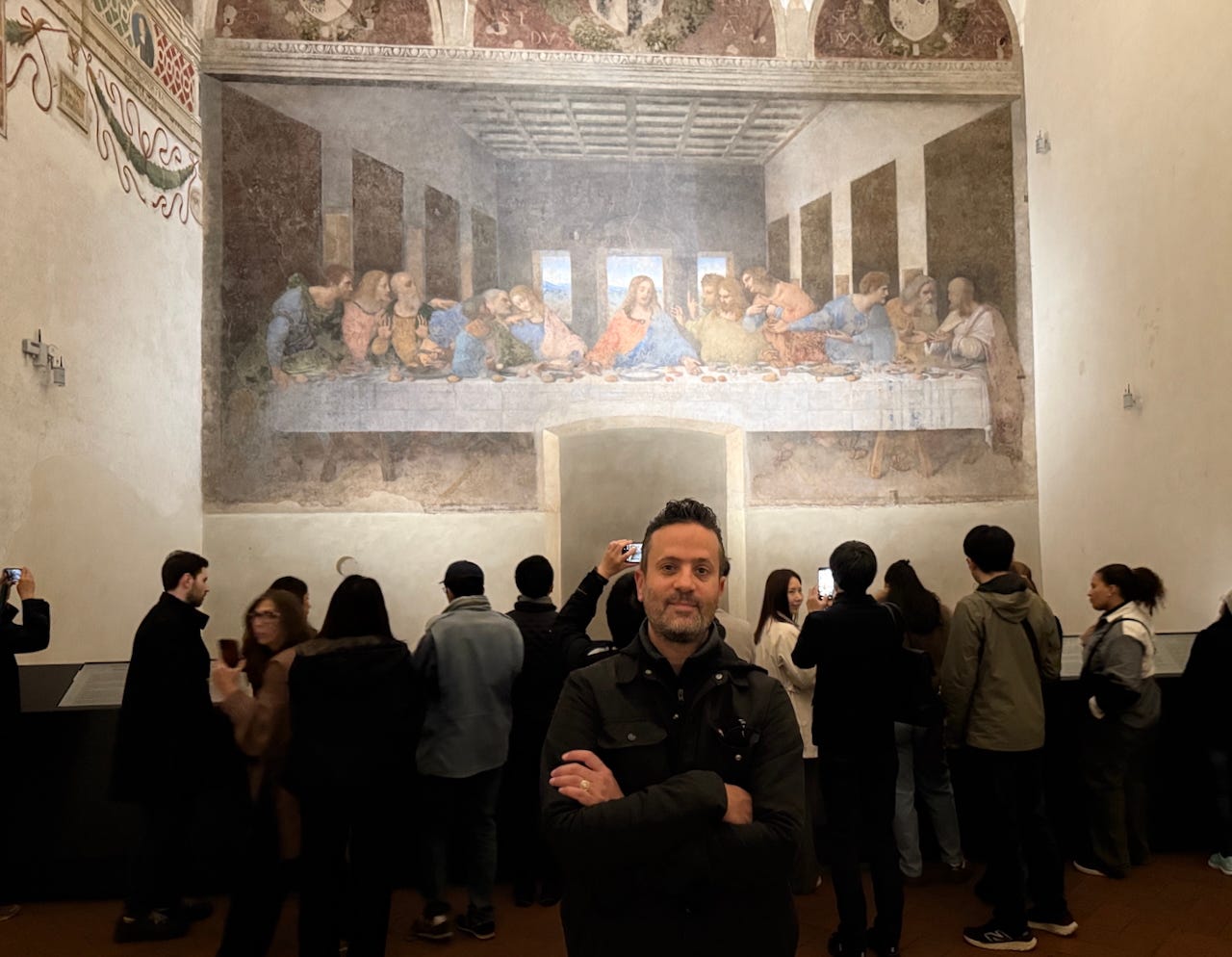
When the door opened, your body reacts before your brain does. Mine did, at least. Around me, most people lifted their phones immediately (I understand the instinct, but it made me wonder how little time we give ourselves to simply look before documenting anything).
Then the room itself takes over. The refectory is long, narrow, dimly lit. It feels almost stripped down so that nothing competes with the wall ahead. The quiet, the scale, and the distance all prepare your eyes for something your memory of reproductions can’t match.
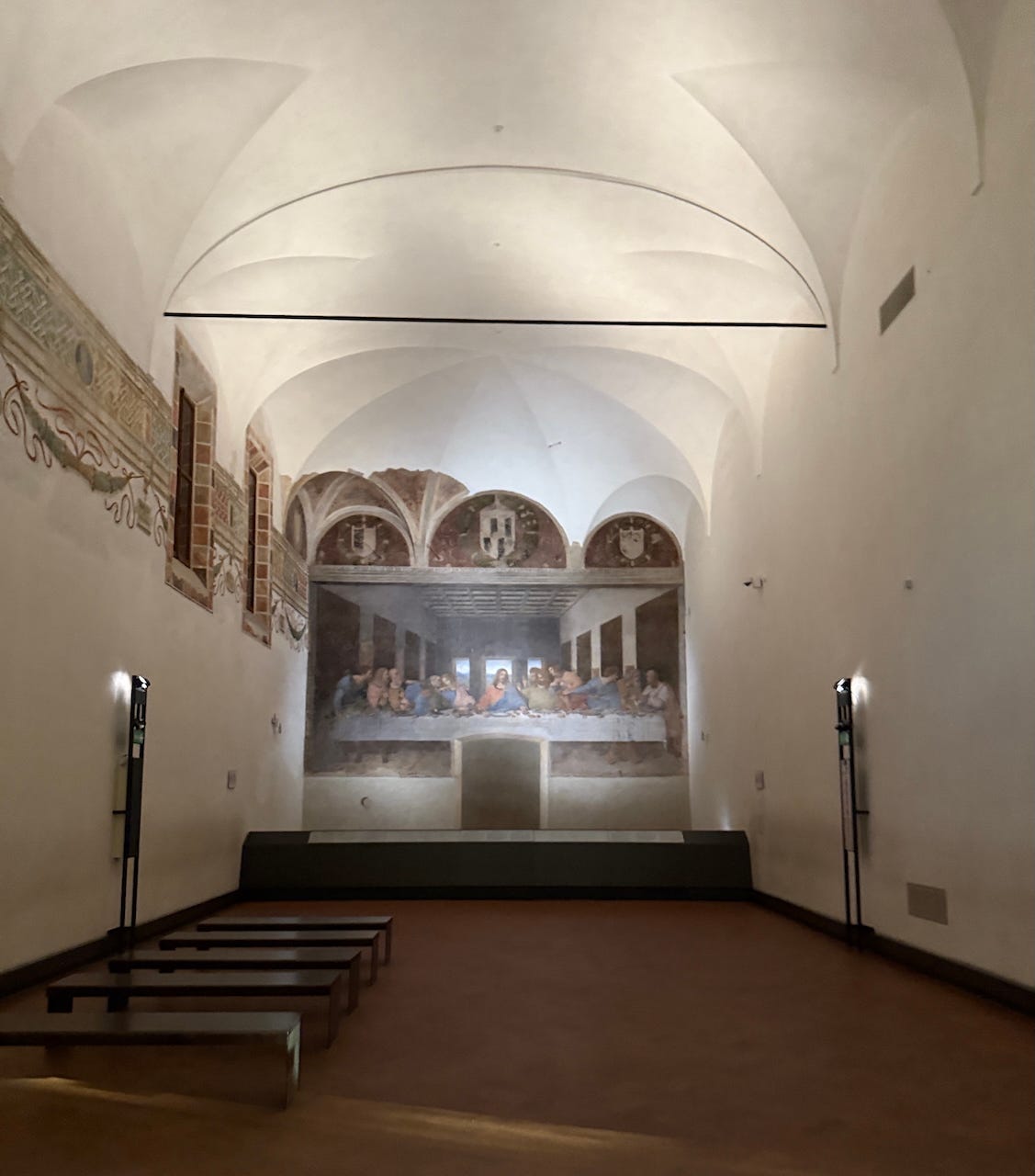
Only after that does the painting reveal itself. The work is enormous, and the space inside it feels like an extension of the room. Leonardo’s perspective aligns the painted architecture with the real one so precisely that, for a moment, the scene reads as continuous space. The gestures, the shock, the calm center of Christ, the ripples of emotion - they all hit at once. And the damaged surface, softened by the dim light, gives the painting an almost floating quality, as if it’s suspended between presence and disappearance. It’s hard not to be moved.
Only later did I realize something that completely reframed the experience. From a technical standpoint, The Last Supper is a failed experiment.
The wall that could not breathe
Traditionally, large wall paintings were done in true fresco: pigment applied on wet plaster. As the plaster dried, the color bonded with the wall and could last for centuries, as long as conditions were reasonable.
Leonardo rejected that method. Fresco dries fast and doesn’t allow for the kind of subtle modeling and slow reworking he loved. So he tried something different: a mix of tempera and oil on dry plaster. In simple terms, he tried to paint an oil painting on a wall.
It was a brilliant idea in theory. It gave him more control over details, color, and light. It also turned out to be a disaster in practice.
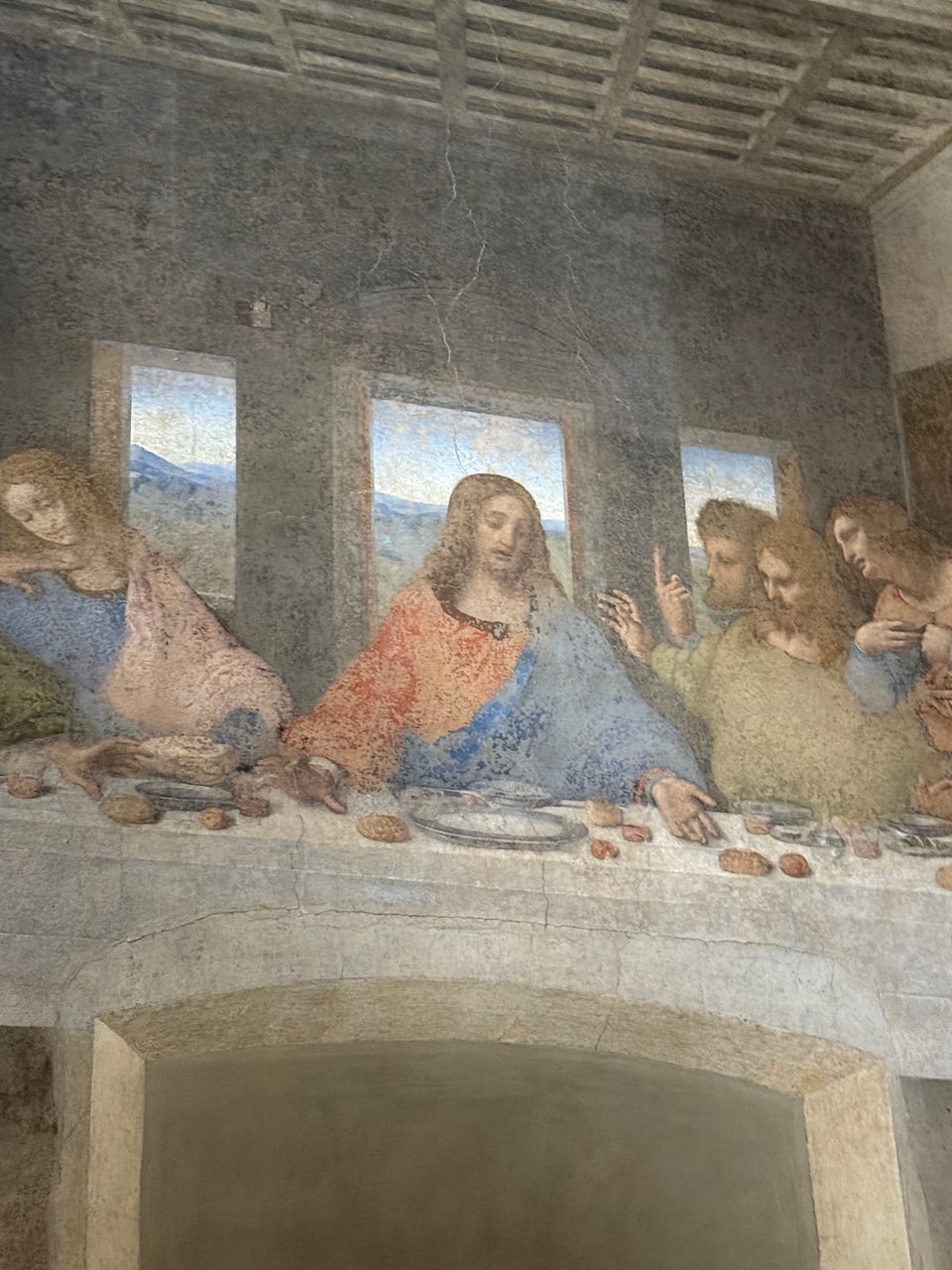
The dry plaster didn’t absorb the paint properly. The wall was exposed to humidity and temperature changes from the kitchen behind it. Because it wasn’t true fresco, the surface couldn’t “breathe.” Within about twenty years, the paint started to flake off. Over the centuries, the work was damaged, repainted, over-restored, and even cut through when the monks decided to open a doorway right where Christ’s feet used to be.
Today, art historians estimate that only a fraction of Leonardo’s original paint remains. In front of you is essentially a wounded painting: a mix of original sections, losses, and restoration. A ghost of what it once was.
Meanwhile, the Crucifixion on the opposite wall, painted at the same time using the traditional fresco technique, still looks remarkably fresh. Donato followed the rules. Leonardo didn’t. Technically, the conservative choice aged better.
And yet no one is booking timed tickets to see the Crucifixion. The world comes for the “failed” wall.
Why? Because the real breakthrough of The Last Supper is not in the chemistry of the paint. It is in the architecture of the idea.
The experiment that did succeed
Leonardo transformed a familiar religious subject into something fundamentally new.
Earlier versions of the Last Supper were often static and symbolic. Christ sits calmly, the apostles line up like chess pieces, everyone has a halo, and Judas is usually isolated on the other side of the table, clearly marked as the villain. Clear, simple, and emotionally flat.
Leonardo strips all of that away.
He divides the apostles into four groups of three, turning the scene into a series of emotional “waves” reacting to Christ’s announcement that one of them will betray him. The painting becomes a psychological drama: shock, denial, anger, confusion. Each figure is individualized through gesture and expression.
He removes the halos. Christ and the disciples sit there as men, in a real room, under real light.
He places Judas on the same side of the table as everyone else, inside the group. Judas is still marked by shadow, posture, and the bag of silver in his hand, but he is not exiled to the opposite side. Betrayal comes from within the circle, not outside it. That choice alone changes how we read the story.
Then there is the staging. Leonardo uses single-point perspective anchored in Christ’s head, and aligns the imagined architecture in the painting with the real architecture of the refectory. The effect is theatrical and intentional. The monks who ate in that room would feel as if they were literally dining in the same space as Christ and the apostles.
So yes, the surface is broken. But the mental model underneath is intact and powerful. What survived is the composition, the psychological depth, the connection between the sacred narrative and the everyday act of eating in that space.
The technique failed.
The idea endured.
What does this have to do with business?
I left the refectory thinking less about art history and more about the work I do. Much of that work - and the keynotes I give to companies - aims to reveal how artists think and what we can learn from them. In this case, the lesson is about experimentation.
We love the word “experiment” as long as the outcome is successful, measurable, and scalable. We celebrate the pilot that becomes a product line, the prototype that turns into a huge success. What we rarely acknowledge is that many experiments fail technically and still succeed conceptually.
They don’t produce a lasting “object,” but they change how people think, design, or work. They open new categories of possibility. They create new language. Leonardo’s wall is literally disintegrating, yet the way he staged the scene reshaped centuries of storytelling and painting.
Business has its versions of this - not the perfect pilot that takes off, but the experiment that collapses commercially and still alters the trajectory of the company.
Take Apple’s G4 Cube. Commercial flop. But the design principles behind it - the radical miniaturization, the precision milling, the reductive manufacturing philosophy - became the DNA of the iPhone and much of Apple’s later hardware. The Cube disappeared; the thinking didn’t.
That’s the parallel. Leonardo’s technique failed on the wall, but the conceptual breakthroughs inside it changed the future of painting. Apple’s Cube failed as a product, but its ideas changed the future of hardware.
We usually judge experiments with one question: Did it work?
Standing in front of The Last Supper, another question feels just as important: Did it change the way we see?
Experiments that matter
Leaders often design experiments for safety: reversible decisions, predictable timelines, limited downside. Necessary constraints - but not sufficient ones. If every experiment must survive intact, you get technically sound frescoes: stable, respectable, forgettable.
The alternative is to design experiments - deliberate, informed, strategically bounded - where the insight outlives the object. These concept-generating experiments shift an organization’s imagination.
A few principles help:
Pursue the possibility, even when the method is uncertain. You don’t know whether the approach will work, but you see something worth trying - and that vision deserves a test.
Separate “survival metrics” from “learning metrics.” Some experiments should be judged by what they reveal, not what they produce.
Protect the fragile edge. Breakthroughs rarely emerge from optimized systems. They emerge from small, exploratory spaces where it’s safe to test unorthodox moves.
The broader shift
We’ve entered a moment shaped by powerful technologies, where efficiency is now table stakes. It still matters, but it no longer sets anyone apart; these tools are pushing it toward commodity status across most knowledge-driven work. Advantage now comes from perspective, human meaning, and the ability to reinterpret problems. Organizations that treat experiments as engines of insight - not just output - will see possibilities others miss.
In that quiet refectory in Milan, I stood in front of a damaged wall that continues to shape global imagination. The surface failed. The idea didn’t.
Not every experiment needs to survive.
But the ones that change how you see might change everything else.
If you’re curating a conference or want me to speak about how artists think and how it is relevant to business, reach out. You can get a sense of what that looks like in our new keynote reel.
If you enjoy Business Artistry and think a friend or colleague might find value in it, please share it with them - that’s how this community grows.
I’d love to hear from you. Whether it’s your thoughts, questions, critiques, or a story of your own, drop me a note at mindset [at] theartian.com or simply reply in the comments.
Thanks for reading,
Nir
The point about separating survival metrics from learning metrics really stands out. A lot of companies talk about experimentation but then judge every pilot by whether it makes money right away, which basically filters out anything that could actually shift thinking. The G4 Cube comparison works well here because it shows how an idea can migrate even when the product dies. Makes you wonder how many insights get buried because the vessel failed.