Business Has a Different Function Than You Think
What Edwin Land and Bette Nesmith Graham understood about business that most MBA programs never teach

When I first started talking about Business Artistry - the idea that business can be approached as a creative medium, as a platform for human expression and not just optimization - I got two kinds of responses.
Artists looked at me with a kind of polite suspicion. To them, obviously I didn’t understand what art is. To some, I was a servant of the capitalistic system.
Business people were more direct. They thought I was naive. Nice idea, they’d say - and you could hear the “but” coming before they finished the sentence. But business is about returns. About efficiency. About growth. The “softer” stuff is fine for the website or Instagram, but in the room where decisions get made, the metric is the metric.
For a long time, I stood in that gap with nothing but a belief. You might know the feeling - when you believe in something, but your friends/family/colleagues call you a dreamer. Or naive. Or simply wrong. I didn’t have a framework, data, or an endless number of case studies. Just a conviction that business could be something more than a system to optimize - that it could be, at its best, a platform for creating human value. I couldn’t fully prove it. I just couldn’t stop believing it.
Then I found Edwin Land
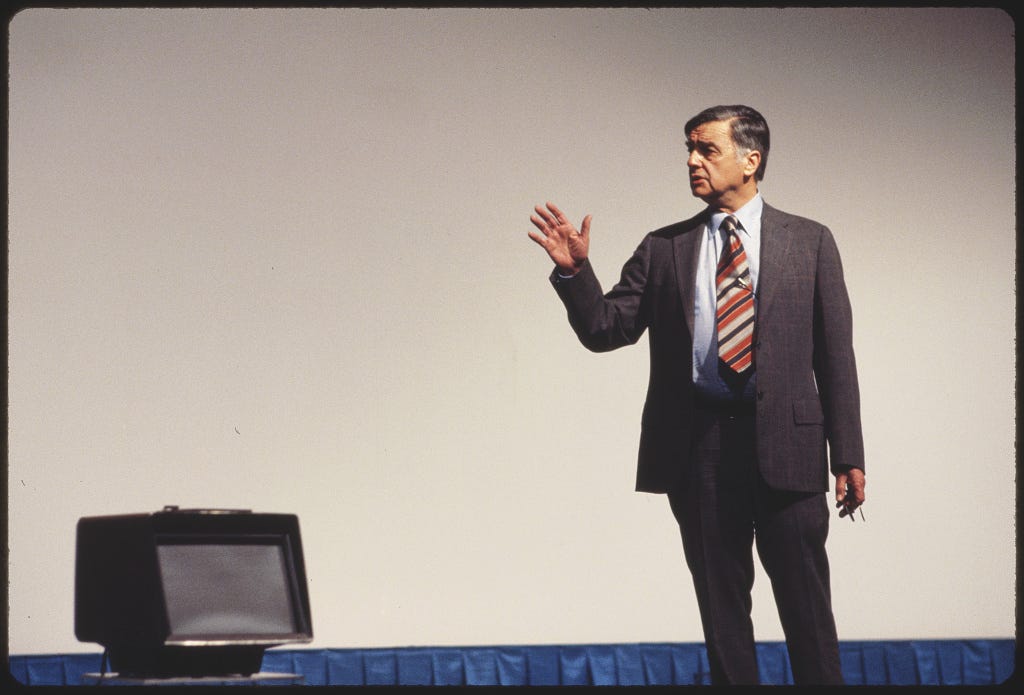
Edwin Land built Polaroid into one of the most innovative companies of the twentieth century - a company that reached $1.4 billion in annual revenue under his leadership. He was a scientist, an inventor, and a businessman. But when asked how he saw himself, he was disarmingly direct: "I suppose that I am first of all an artistic person." He understood that those things were not in conflict. An MBA - and to be clear, I am an MBA graduate - might look at Polaroid’s revenues and credit the operations, the efficiency, the financial discipline. And those things mattered. But I think something else was driving it - something Land revealed in a single sentence from a speech he gave in 1956:
“The function of industry is not just the making of goods. The function of industry is the development of people.”
I’ve thought about that line for years. It doesn’t read like a mission statement written by a committee. It reads like a personal belief - something Land had worked out for himself and was willing to say out loud, in a room full of people who probably found it strange. He wasn’t positioning Polaroid as a purpose-driven brand. He was saying something more fundamental: that what a company produces is secondary to what it does to the people inside it and around it.
That’s not naive. That’s a completely different idea of what business is for.
One might look at Land as a single unique individual in history. But this way of thinking can be found across business leaders - in different industries, different eras, different circumstances.
A means, not the meaning
Bette Nesmith Graham came to the same place from a completely different direction.
Nesmith worked as a secretary in Dallas in the 1950s. A single mother working to support her son, she had a practical problem - making mistakes on her typewriter with no way to fix them. As a painter, she brought her solution from canvas to the business world, painting over the errors with white tempera. What started as a practical solution became Liquid Paper, eventually sold to Gillette for nearly fifty million dollars. A woman - solo founder - who built a successful business and exited alone. In the 1970s. By any conventional measure, a success story about persistence and entrepreneurship.
But what Nesmith Graham said about it is what matters here.
“The true value in business is never the dollar, but in the benefit that it brings to humankind. Money does not solve problems. It is a tool.”
She wasn’t performing generosity. She wasn’t doing stakeholder management. She genuinely believed that the point of what she had built was the benefit it created - and that the money, real as it was, was instrumental. A means, not the meaning.
A floor, not a ceiling
Two people, completely different contexts, separated by industry and circumstance, arriving at the same conviction: that business exists to create human value, and that treating it as purely a system to optimize misses what it can actually be.
I think about this often when I hear the language that surrounds business today. Shareholder value. Efficiency gains. User growth. Cost rationalization. These are not wrong things to care about - but they describe a floor, not a ceiling. They tell you the minimum the business must do to survive. They say nothing about what it could mean.
The leaders who understood this weren’t soft. Land spent years fighting the financial analysts who wanted Polaroid to be something more predictable, more manageable, more legible to Wall Street. He had a word for that pressure. He called it shallow.
“The essence of business leadership,” he said, “is to be able to turn your back on the demands of the financial world. Its analyses are never profound.”
That’s not naivety. That’s a different kind of discipline - the discipline of someone who has decided what business is actually for, and refuses to let a spreadsheet tell him otherwise.
I’m not suggesting every business leader needs to quote Land or Graham. I’m not suggesting that profit doesn’t matter, or that the operational realities of running an organization can be wished away.
What I’m suggesting is simpler than that. The belief that business can be a platform for human value - that the development of people, the benefit to humankind, the creation of something that means something - is not a luxury reserved for artists or philosophers. It has been held, quietly and seriously, by people who built real things in the real world.
They were not validated immediately. They were often told they were wrong. They held the conviction anyway.
That, to me, is where Business Artistry begins. Not with a framework. Not with a case study. With a decision about what you believe business is actually for - and the willingness to act from that belief before the room agrees with you.
If this resonates with you, I explore exactly this in my course on Creative Leadership. It’s built for leaders who want to develop the judgment, vision and courage to bet on original ideas in their own organizations.